Two all-time piano greats are visiting Boston this weekend, and I had to see them both. First up, on Halloween night, the most genial of piano virtuosos, Bill Charlap. He was at the RegattaBar in the Charles Hotel, with his sensitive, disciplined trio of David Wong, bass and Dennis Mackrel, drums. Bill is the master of dynamics, of the elegant run, of how to keep a solo interesting. Impeccable classical technique in the service of swing.
Can an acknowledged master like Bill be said to be under-appreciated? I think so, at least by the critics, too many of whom are eager to dismiss him as a purveyor of the dreaded standard repertoire. Yes, he played a Cole Porter tune (“In The Still of the Night”) and a Richard Rodgers tune (a medley of “If I Loved You” and “It Never Entered My Mind”), but his set also included little-heard classics by Tommy Flanagan, Herbie Nichols, Gerry Mulligan, and Jim Hall. His approach to them is entirely original. What his critics miss is that he uses standards only as a springboard for his own wild imagination and scorching pianism. The trio played for 75 minutes; it seemed like 15.
Joe Farnsworth is a man of many mottos: “Listen to learn, and learn to listen;” You can never be wrong if you know the song;” and, of course, “Time to Swing.” He’s more than a drummer – he is a sensitive, generous musician with big ears and a big heart. His stories, often quite funny, are instructive, whether you aspire to play this great music or just appreciate it more deeply. It was a joy talking to him about his life and times for DownBeat Magazine. Now, for those who would like more of Joe and his stories than the magazine had room for, here’s the “director’s cut” of my September 2025 feature.
{UPDATE: As of about October 2, the online version of this article on DownBeat.com has been expanded to include the full text of the article below. You can read it here or read it there! – Allen}
Joe Farnsworth Plays “The Big Room”
By Allen Morrison
When he was 12 years old, the hard-swinging veteran drummer Joe Farnsworth had a fateful encounter with his idol Max Roach, the bebop pioneer.
Prior to that, Farnsworth had already been playing drums and attending jam sessions in and around his hometown of South Hadley, MA, thanks to his four older brothers, musicians all. As a budding young drummer, he had been emulating Buddy Rich and Sonny Payne of the Count Basie Orchestra. He used to play along with the Count’s “April in Paris.”
“Then my older brother John had me learn Charlie Parker’s version of ‘Slow Boat to China’ and ‘Chi Chi,’ with the great Max Roach on drums,” Farnsworth told me in a pair of recent Zoom interviews. “When I started hearing Max, that was like the big change in my life… (to) that style of music and drumming.
“Around that time, my brother John drove me to UMass-Amherst to see Roach give a masterclass. We came into the room, and there was a guy playing piano. It was just the three of us. I’m like, ‘Damn, is that Max Roach?’ Because I had never seen his face, and he was playing piano. Then he stopped playing and says, ‘What are you guys here for?’
“I said, ‘I’m here because I want to play like Max Roach.’ He didn’t answer; he just kept playing. About 10 minutes later, he asked, ‘Do you know who Billy Strayhorn is?’ I said no. He kept playing music – beautiful music – on the piano. He finally stops and says, ‘If you don’t know Billy Strayhorn, you don’t know anything about the drums.’
“I was 12, and I didn’t really know what he meant by that. But I know now… He meant that… you first and foremost are a musician, and you need to learn about music… and open your mind and ears to all the possibilities… Then you’re able to play music instead of just playing drums.”
Farnsworth’s jazz education continued with private lessons with the legendary drum teacher Alan Dawson and at William Paterson College. “But,” he says, “the school I wanted to go to was the school of Cedar Walton and George Coleman.” He headed to New York City.
—————
When you see Farnsworth on a gig, he is always dressed to the nines. It’s his way of paying homage to the jazz masters. “I’ve been doing it ever since I started making gigs in 1986. Art Blakey did it. McCoy. Miles. Charlie Parker. That was the thing to do. My first big gig was with Benny Golson. He always wore a suit. I did, too. Milt Jackson, George Coleman, Cedar Walton. I wanted to be like that.”
Coming out of the hard bop tradition, Farnsworth, 57, has played with a formidable list of jazz masters, including Tyner, Walton, Golson, Coleman, Horace Silver, Harold Mabern. He toured with Diana Krall and spent 16 years with Pharoah Sanders. He is a charter member of the supergroup One for All with his former Paterson classmate Eric Alexander. In recent years he has helped nurture – and is sought out by – a younger generation of musicians, including pianist Emmet Cohen, in whose trio he plays, and the sensational young tenor player Sarah Hanahan.
Both Cohen and Hanahan are featured on his latest album The Big Room (Smoke Sessions), his 8th as a leader. Rounding out the A-list of players is Joel Ross, vibraphone; Jeremy Pelt, trumpet; and Yasushi Nakamura, bass.
Farnsworth’s drumming is characterized by crispness; rhythmic clarity; melodicism; a sensitive, musicianly use of dynamics; and a bulletproof sense of swing. His impeccable technique has given him the freedom to celebrate a tradition that includes drummers from Roach to Roy Haynes, Billy Higgins, and Tony Williams, while enjoying the freedom to go well beyond that tradition.
In his liner notes for Farnsworth’s 2020 album Time to Swing, drum master Billy Hart likens him to an orchestra conductor, writing, “Somehow the conductor keeps perfect time for 80 musicians without hitting anything. How does he do that? It’s a result of his knowledge of the music, and the enthusiasm that this knowledge gives him is what he shares with the rest of the orchestra. I think that’s what Farnsworth does.”
Talking by Zoom about his friend and colleague, Emmet Cohen said, “I think he’s one of the greatest ever. An absolute legend. He used to go down, week after week, and sit by Elvin Jones, Tony Williams, Billy Higgins, and Louis Hayes, and would just absorb their musicality and their power… It feels so good to be around him. And you know he’s got your back. I never imagined I’d have a friendship with someone 20 years my senior that would feel so kindred and overwhelmingly positive in my life.”
The younger players admire his discipline, an almost monastic dedication to the art form, which comes out in many ways: yes, the suit, tie, and pocket square; but also the way he takes care of his body and spirit. “It’s the standard that he holds for himself,” Cohen said. “Dressing. Running every day. Going to church no matter what the language or what country he’s in. Staying centered. I’ve never seen him falter. He’s been an enormous blessing in my life.”
———
South Hadley, Mass., pop. 17,000, in the western part of the state, was never exactly the jazz capital of the world. Yet being the son of a high school band director, and with four older brothers who all played, Farnsworth’s life was filled with jazz.
“Listening to music was the biggest thing in my life,” he said. “It was really important to me. Still is. I used to love having listening parties with my brothers. We had thousands of records.
“I used to sleep with my oldest brother, David. He was the original drummer. He had a nice set of Ludwigs. He’d go off to school and say, ‘Don’t touch my drums.’ So, I’d look out the window until I couldn’t see him anymore, and I’d plop on the drums.”
The budding musician would go from room to room in the house in South Hadley, listening to his brothers’ favorites. With David, he would listen to the Temptations and O’Jays, but also the Buddy Rich and Basie bands. “The next room over was James. He was a saxophone player and was into Sonny Stitt and Sonny Rollins… John was a trombone player, so he liked Chicago, but he was also into Charlie Parker, J.J. Johnson, and Clark Terry. So, I’d go into that room and listen to that. I like to joke that it was like having my own mini 52nd Street.”
———–
Dawson’s approach to teaching young drummers was to encourage a holistic approach to the music. It wasn’t just about the drumming; it was about really learning the tune, melody and lyrics, and playing what was best for it.
Farnsworth does the same with his own students. He recalled the first tune that he learned from Dawson was “Old Devil Moon.” “It was the J.J. Johnson record with Elvin Jones on drums. (He had me) play the melody. That was the first time that I would sing the melody while I was playing. And I remember him saying, ‘Well, the good thing is that you have a love for Max Roach.’ But the main part of the lesson was (him saying) that ‘you’ve got to learn how to sing the melody freely so you’re able to play more freely.’” In other words, instead of emulating Roach, Dawson wanted him to learn the song.
“For 40 years, I tried to play the perfect Max Roach solo. I wanted to be him and guess what? It never happens.” It’s only in recent years, Farnsworth said, that he stopped chasing Roach and his other drum heroes and concentrated on his own unique voice.
When he got to New York in 1986, he discovered the musician union phone book that belonged to his older brother John, who lived on 106th and Amsterdam Avenue. He started cold-calling his jazz heroes who lived in New York. Some of them hung up on him. But when he reached the “T” section, he dialed iconic bebop drummer Arthur Taylor, who agreed to take him on as a student.
“A.T. said, ‘You’re lucky you’re on time, because if you’re not on time you can’t play in time.’ The first few lessons we sat there and just listened to Sarah Vaughan sing.” Taylor told his young charge a story about how he was once playing a ballad, and the iconic Basie drummer Papa Jo Jones came up to him and hit him in the head.
“He said, ‘Hey, you little goober head, you sound terrible!’ And A.T. was like, ‘Hey, man, why’d you hit me in the head?’ And he says, ‘You don’t know the tune!’ And A.T.’s like, ‘Yo, come on, man, it’s just a ballad.’ But Papa Jo was right.” Farnsworth remembered that he and Taylor listened to Vaughan sing “Don’t Blame Me,” then talked about how, when Lester Young and Miles Davis were learning a ballad, they would listen to Sinatra sing it then Charlie Parker play it.
Like Dawson, Taylor encouraged the young drummer to learn the lyrics, saying “If you want to be part of the glory, you gotta know the story,” and “You can never be wrong if you know the song.”
—————–
What is “the big room,” the concept behind Farnsworth’s new album? It seems to have more than one meaning, describing a place where constraints on expression disappear, but also an approach to time.
Farnsworth has said, “Jackie McLean talked about being at such a height of greatness that you’re able to go into The Big Room, where there’s no furniture and no paintings on the walls. You’re able to arrange the room anyway that you want, but only a few people ever get there – greats like John Coltrane or Ornette Coleman. It’s like what, Roy Haynes said about playing with Coltrane – it’s freedom with discipline.”
Cohen thinks the concept also has to do with the way the masters talked about time. “Joe likes to call me “Emit,” Cohen said, “because Joe’s teacher, Arthur Taylor used to say ‘It’s all about Emit’ – ‘time’ backwards. It comes down to the space between the quarter notes when you’re swinging.”
The sense of “freedom with discipline” is palpable on the record. Remarkably, it was tracked in a single day during a recording session on the stage of Smoke, the Upper West Side nightclub that spawned the label. The eight songs cover a wide spectrum, from post-bop burners like Hanahan’s opener “Continuance” and Cohen’s “You Already Know”; to altered blues (Pelt’s “All Said and Done”); pensive ballads (Joel Ross’s “What Am I Waiting For?”); and the triumphant boogaloo (Farnsworth’s “Prime Time”) that closes the album.
For Farnsworth, the music is never about ego or chops. It’s about being the best person you can be, on and off-stage.
“I remember meeting Billy Higgins and asking him why he smiled so much. ‘Smiling Billy Higgins,’ people called him. He told me he made changes so he could become happy, joyous, and free. He changed his lifestyle, stopped doing certain things. Became Muslim, started listening to God. Freed himself from toxic relationships. Set healthy boundaries. Certain people he had to let go of.
“I was determined to be like that, but I didn’t know how. About 13 years ago, I decided to do the same thing – change my life. Being a father of three, I stopped hanging out after the gig, stopped drinking. I decided to become Catholic – I wasn’t anything before that. I started listening to a higher power.
“‘Listen to learn, and learn to listen’ – that was what Art Taylor taught me. I wanted to be happy, joyous, and free… to be a better father, a better drummer, and be of service to younger people.”
Farnsworth once toured with Benny Golson. Two legendary players, trombonist Curtis Fuller and trumpeter Art Farmer, joined the band for its final dates. “One night when Art played ‘I Remember Clifford,’ I noticed that Curtis started to cry. Little did I know that Art was dying of cancer at the time.
“Being on the road with these guys showed me the level of fellowship, commitment, love, and respect that they had for each other. I learned just how big their hearts were. What I learned was that they were giants of men. The instruments (they mastered) were just by-products.
“Art gave me a pocket square to put in my jacket. He said, ‘Hey, man, you need to look good if you want to hang around me. Don’t embarrass me.’ To this day I wear it.”
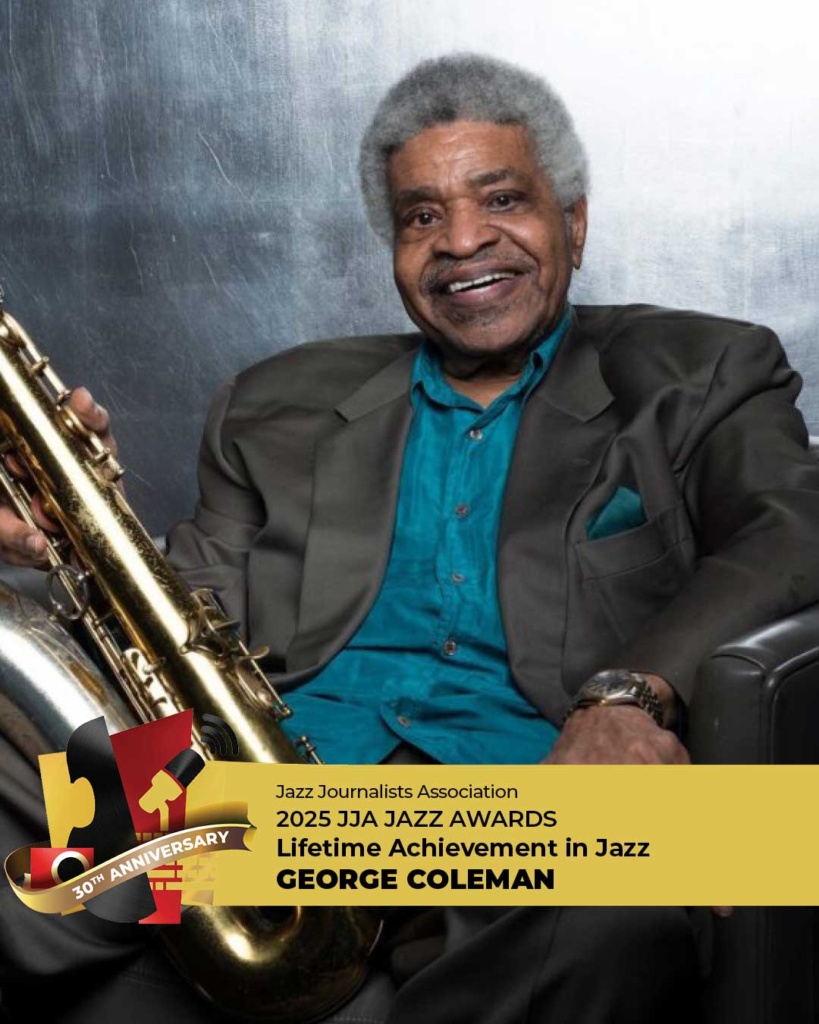
Congratulations to the 2025 Winners of the 30th annual Jazz Journalists Association Jazz Awards. Pleased to see awards go to some of my favorite artists, including George Coleman, winner of the Lifetime Achievement in Jazz award. A special shout-out to my friends in New York Voices, who were cited as best jazz vocal group!
Crossing Paths (Smoke Sessions) is the album pianist Renee Rosnes always wanted to make. My cover story in the January DownBeat Magazine is now online here. The album features several Brazilian music icons (Edu Lobo, Joyce Moreno, Maucha Adnet) and an amazing band including Chico Pinheiro, Chris Potter, John Patitucci and other masters. Let me know what you think!
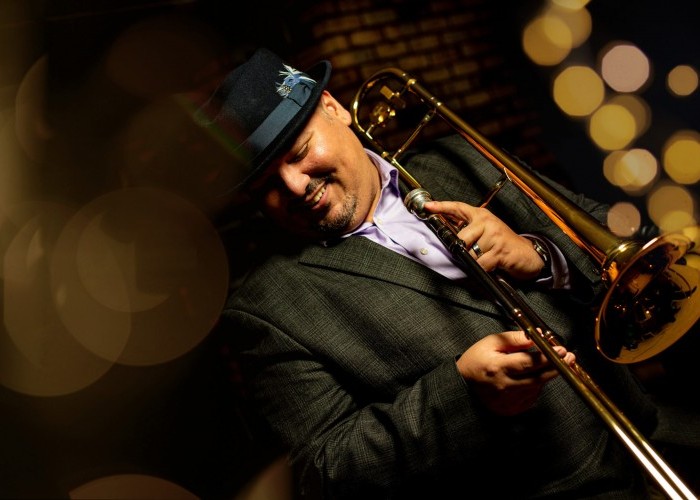
Michael Dease is not resting on his laurels. Long considered one of the jazz world’s most accomplished trombonists, he is deeply engaged in establishing himself as a compelling voice on a wholly different instrument, one that isn’t even in the brass family – baritone sax. Family man, beloved teacher, and A-list sideman, I loved talking with him for this feature in the October DownBeat.
Samara Joy sang to an overflow crowd at the 2023 Newport Jazz Festival. (Photo: Mark Sheldon)
For my birthday weekend, I gave myself a present and an assignment – review the 2023 Newport Jazz Festival. Here’s the result, at DownBeat Magazine. The nation’s oldest jazz festival was never only about jazz. This year’s edition presented the full gamut of jazz and “jazz-adjacent” music, including big personalities like Samara Joy, Jon Batiste, and Herbie Hancock.
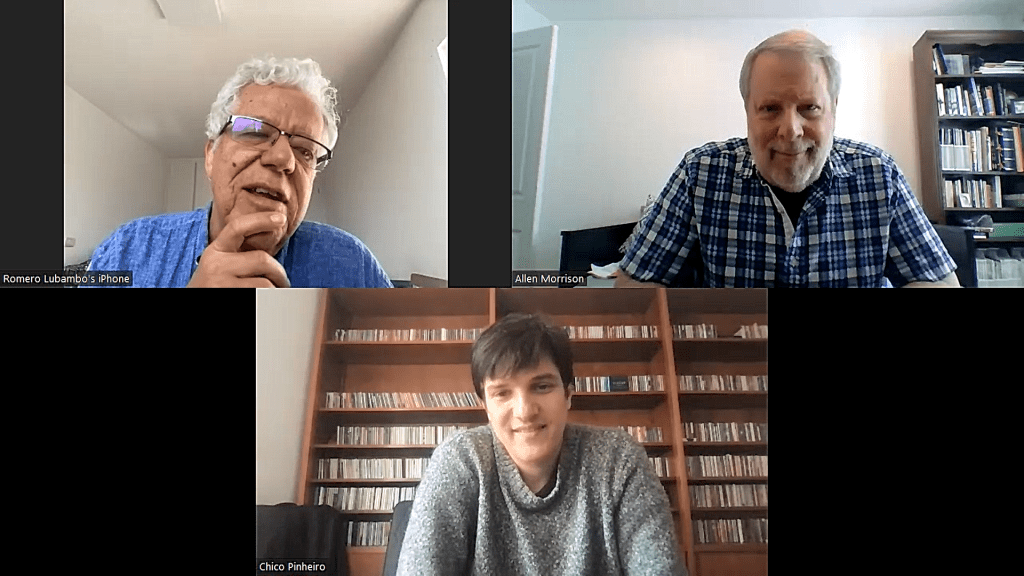
What a pleasure to hang with the Brazilian master guitarists Romero Lubambo and Chico Pinheiro for this article in TIDAL Magazine! They recently recorded their first album as a duo, “Two Brothers,” largely for the same reason that some of the world’s leading recording artists hire them: They love being accompanied by each other.
“Shiri is my favorite kind of singer (and human, for that matter) — open-minded, creative and honest.” –Tierney Sutton.
Shiri Zorn, born in Israeli and now living in Saratoga Springs, NY, received a lesson with Sutton, the world-renowned jazz vocalist, as a birthday present from her guitarist partner. Ultimately, Sutton became so enamored with the Israeli-American singer that she offered to fly to Saratoga from California to co-produce her debut album, Into Another Land (CD Baby), in a trio with guitarist George Muscatello and Brazilian percussionist Mauricio Zottarelli. It’s really something to hear – cool, cerebral, intense, swinging.
“In Canada once, a student asked me, ‘How do you reconcile what you want to play with what the audience wants to hear?’ And I said, ‘Man, as I get older, I really want to play music that people want to hear.’ I don’t even understand what the question is.”
Wayne Shorter at Jazz at Lincoln Center (photo by Fran Kaufman)
Wayne Shorter was a hero to everyone in the jazz world, a visionary composer and an unequalled improviser who retained a childish sense of wonder and play. There was no one like him. I’m so glad I got to see him play live with his quartet at Jazz at Lincoln Center in 2012. Here’s how the piece began:
An hour before pianist Danilo Pérez went onstage with the Wayne Shorter Quartet on April 28 at Jazz at Lincoln Center’s Rose Theater, I asked him what the group would be playing. He laughed. “We never know, man.” Well, how did it go last night? “It was exciting—and scary.”
It was an honor to celebrate the innovative pianist/composer Geri Allen on her induction into the DownBeat Hall of Fame. For this article in the August 2022 issue, I spoke to her manager and close friend, Ora Harris, who generously shared many wonderful stories with me; her collaborator and friend, the masterful drummer and composer Terri Lyne Carrington; and Jana Herzen of Motéma Records, her last label before Geri’s untimely passing at age 60. Thanks to DownBeat Editor Frank Alkyer for the assignment.
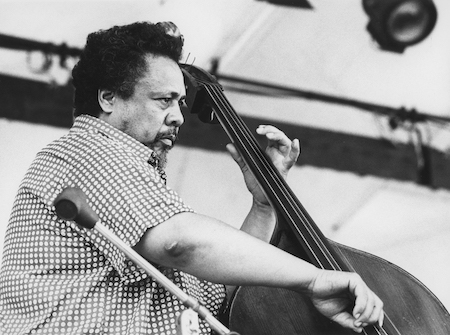
For Charles Mingus’s centennial, DownBeatasked me to do a deep dive on the composer, bassist and singular American cultural figure. In this package of three pieces, I explore the place Mingus occupies in the popular imagination, by all accounts well-deserved, as a force of nature, an iconoclastic truth-teller, a volatile, emotional man with a violent streak. But his many friends and fellow musicians, people who knew and loved him, remember a different side: the spiritual seeker, poet, esthete and philosopher; the bandleader who took pains to treat his musicians fairly; and, above all, the artist he was right down to his bone marrow. Among the artists and critics I interviewed: Christian McBride, Charles McPherson, biographer Brian Priestley, and Jazz at Lincoln Center’s Vincent Gardner, who served as musical director for JALC’s Mingus centennial tribute. The main article is here. A sidebar on the making of “Epitaph,” Mingus’s magnum opus, is here. Another piece about new Mingus recordings and tributes is here.
Thurman was the first woman to tour and perform full time with Wynton Marsalis and the Jazz at Lincoln Center Orchestra. (Photo: Courtesy of Camille Thurman)
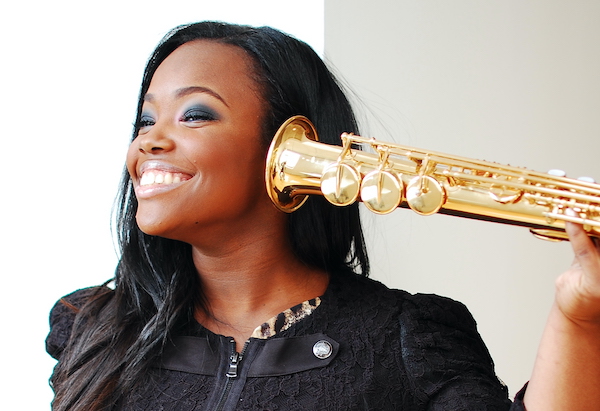
Imagine if Sarah Vaughan played saxophone like Dexter Gordon. That’s approximately the effect when the 35-year-old singer and tenor saxophonist Camille Thurman performs. She told me about her struggles with sexism and crippling self-doubt in my interview with her, from the March 2022 @DownBeatMag.
Charles Mingus – prolific American composer, bass virtuoso, memoirist, poet, notorious truth teller, and all-around badass – would have turned 100 years old this year. I was delighted when @DownBeatMag asked me to write an appreciation of Mingus and his place in jazz history – delighted, and a bit intimidated. How on earth could I summarize his life and contributions to jazz in six magazine pages, give or take? You can judge how well I did soon. My story will be in the May issue, hitting the streets approximately April 1.
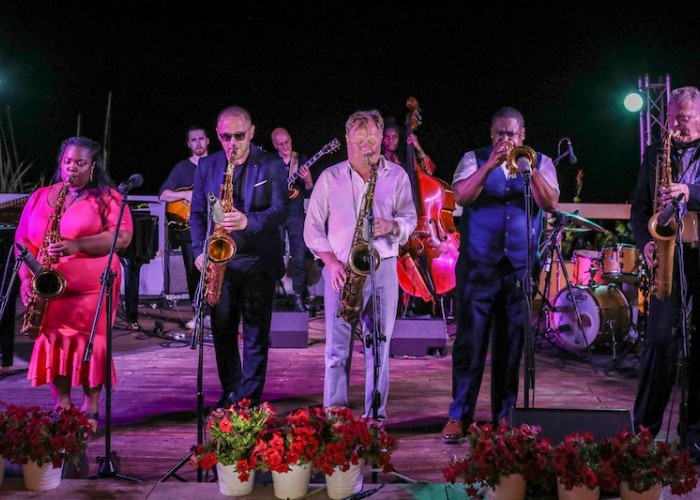
What a beautiful experience it was to be among the first wave of American tourists coming back to Italy last week. I was there to attend “A Night in Anzio,” an invitation-only jazz party in the seaside town south of Rome, assembled by Polish saxophonist Sylwester Ostrowski. Here are my impressions of the experience on Downbeat.com. The line-up included four great tenor saxophonists – Ostrowski, Igor Butman, Alexander Beets and Camille Thurman – Green. Take a look at the video here:
Their version of Dexter Gordon’s song “Cheesecake” is a classic. I especially loved Igor’s solo at about 53:00. Big thanks to Sylwester, Arlette Hovinga and Lois Gilbert of @JazzCorner.com.
Goldings as “The Guy with the Gig” (l), and “Hans Groiner.”
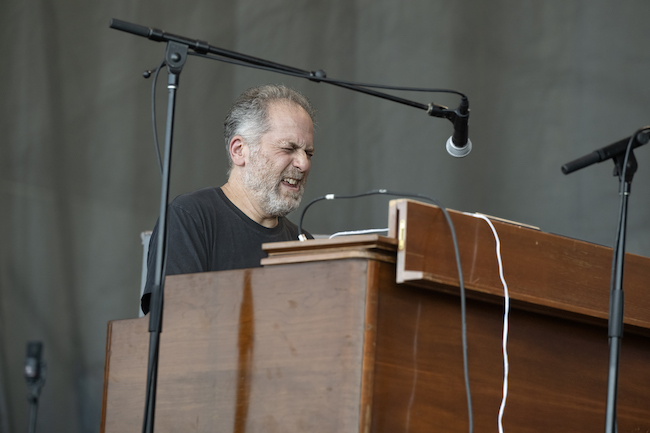
More than a gifted pianist, organist, and 20-yr member of James Taylor’s band, Larry Goldings is also the brilliant comic mind behind the viral CPAC “national anthem” video and, as most jazz fans know, the madcap “Hans Groiner” character, an “expert” on Thelonious Monk’s music who “improves it by making it more relaxing and less offensive to the ear.” Many thanks to Mac Randall of JazzTimes for publishing my interview with Larry. (BTW, don’t miss the priceless “Groiner interview” – an Easter egg embedded within the article.) #LarryGoldings #HansGroiner #JamesTaylor
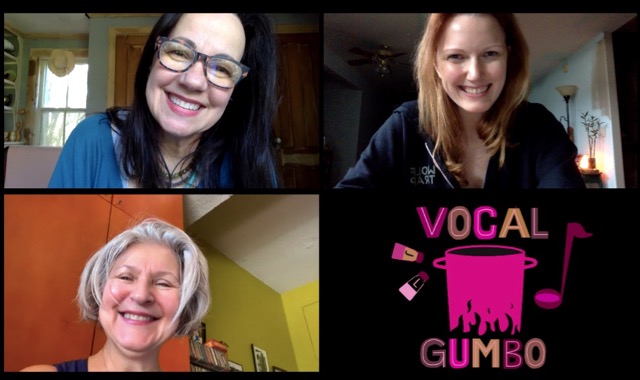
The Vocal Gumbo team: Lauren Kinhan (top left), Janis Siegel (bottom left) and Laurie Green. (Photo: Laurie Green)
A little over a year ago, Janis Siegel of The Manhattan Transfer arrived home from an aborted tour. “At first we all thought, OK, I’m sure we’ll be back at work by the summer.” When that didn’t happen, Janis and her buddy Lauren Kinhan of New York Voices started figuring out a way to convert their monthly “Vocal Mania” shows at NYC’s Zinc Bar to a live-streaming online format. The result, they told me for DownBeat Magazine, is Vocal Gumbo. My interview with Janis and Lauren.
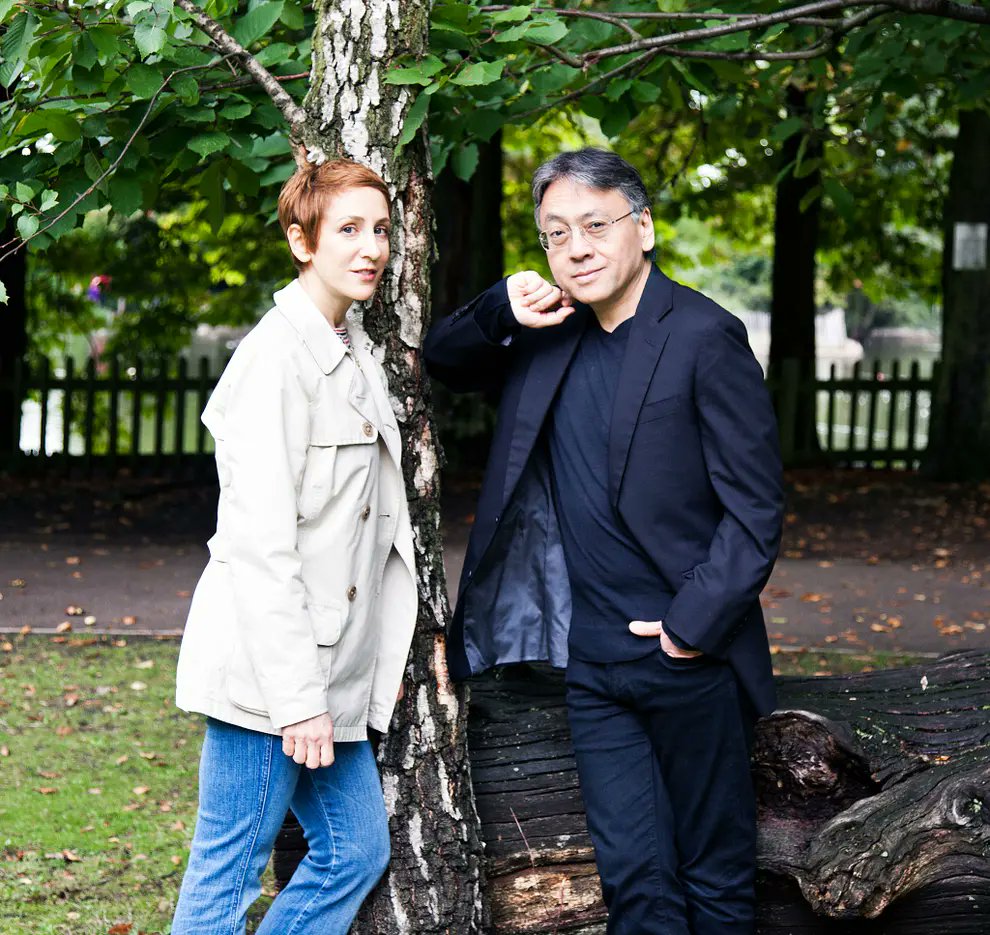
I think it’s safe to say that Stacey Kent is the only jazz singer to have a Nobel Prize-winning novelist writing lyrics specifically for her voice. That novelist is Kazuo Ishiguro. Stacey, Ishiguro and Jim Tomlinson, Stacey’s musical director and husband, are the subjects of my piece in Jazziz Magazine. (Free trials of Jazziz are available if you’re not a subscriber.)
What a pleasure to interview Sergio Mendes, one of my musical heroes since I was a kid. The article appears in TIDAL Magazine, the highly readable online publication of the TIDAL streaming service (owned by Jay-Z).
Here’s one bit that didn’t make the final piece:
“Mas Que Nada” – Sergio’s signature song since Brasil ’66, a song that became the first-ever worldwide hit in Portuguese. The title means, approximately, “Yeah, right,” sarcastically, in Brazilian Portuguese. Sergio recalled when he heard the song for the first time:
“It was in Bottles Bar (the legendary Rio jazz hangout that witnessed the birth of Bossa Nova), maybe ’61 or ’62. This young kid, Jorge Ben, came in with his guitar and started playing it. It was so different from the very melodic stuff Jobim would do, a different vibe. But a great chant! When I play it in Japan, the Japanese sing along with it – it’s like the national anthem!”
I asked if he had any idea the song could become such an enormous worldwide hit in its original language. “Never!” he said. “When I first heard my record of it on the radio [in 1966], I called Herb [Alpert, his producer at A&M Records]. He said, “Sergio I think we’ve got a big hit here!”














 Allen Morrison - Music Journalist, Jazz Pianist, Songwriter, Lecturer - Long Island, NY
You must be logged in to post a comment.