Category Archives: Music Writing and Clips

Two giants of Brazilian music, Veloso & Gil, celebrate 50-year friendship in Brooklyn

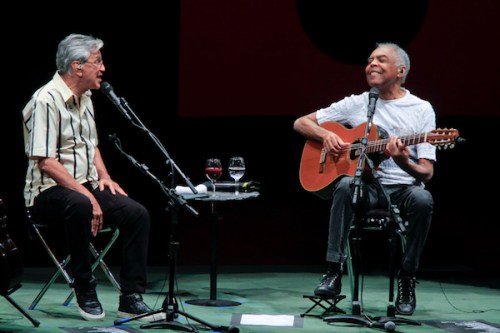
April 20, 2016 Brooklyn, NY ;  Caetano Veloso and Gilberto Gil in concert - Two Friends, One Century of Music at BAM's Howard Gilman Opera House on 4/20/2016. Photo ; Rahav Segev/ Photopass.com / BAM

April 20, 2016 Brooklyn, NY ; Caetano Veloso and Gilberto Gil in concert – Two Friends, One Century of Music at BAM’s Howard Gilman Opera House on 4/20/2016.
(Photo: Rahav Segev/ Photopass.com / BAM)

The two legends of Brazilian popular music are something akin to poets laureate in Brazil. On April 20-21, they brought their world tour to the Brooklyn Academy of Music.  My review from DownBeat (April 2016).

Caetano Veloso and Gilberto Gil Celebrate 50-Year Friendship in Brooklyn

When the curtain rose, revealing the two un-prepossessing, silver-haired gentlemen seated center-stage and already strumming their acoustic guitars, the audience, a roughly equal mix of Americans and Brazilians spanning all age groups, shouted in recognition, not unlike the way one might greet old friends at a class reunion.

In Brazil, they are known by the single names “Caetano” and “Gil.” Beyond pop stars, Caetano Veloso and Gilberto Gil, who have been friends since they met in 1963, are something akin to poets laureate in Brazil. This was the second night (April 21) of their two-night New York stand at the Brooklyn Academy of Music’s (BAM) Gilman Opera House, the latest stop on a joint world tour in which they played 44 concerts in 21 countries and 35 cities, including U.S. stops in Los Angeles, Oakland, and Miami. The BAM concerts had been sold out for weeks.

The legendary Bahia natives, both 73, played 30 songs over two hours, making the ornate, high-domed opera house as intimate as their own living rooms. Over the course of the evening, they covered much of their 50-year careers in a show entitled, “Dois Amigos, Um Século de Música (Two Friends, A Century of Music).”

For much of that era, their careers have intertwined. Leaders of Tropicália, a late-1960s movement that was both musical and political, each man has reflected and influenced the course of Brazilian society ever since. They began with sambas and bossa nova, then influenced by Dylan, The Beatles and Jimi Hendrix, among others, their music became impressionistic, sometimes even psychedelic. Their songs were often spiked with social commentary and rebellion against both the repressive authoritarian regime that ruled Brazil and the moral strictures of the country’s buttoned-up Catholic culture. It landed them in jail for a short time, followed by political exile in England, where they continued to write and record. When they were finally permitted to return to Brazil in 1972, they were bigger than ever.

Caetano’s style is hard to describe and has no real analogue in America; imagine a cross between Dylan, Jacques Brel and Pablo Neruda, and you’d be roughly in the right ballpark. His lyrics are by turns political, sensual, and metaphysical. Gil’s music is both traditional and modern, combining regional, folkloric and urban styles of Brazil with American blues, pop, rock and roll, and later pan-African and Caribbean motifs. Caetano is more the sweet-voiced intellectual, Gil the earthy, multi-cultural, spiritual heart of Brazil. Their styles complement and reinforce each other.

Although Brazil is currently in political turmoil once again, the artists offered no commentary on the pending impeachment of the current left-leaning president, Dilma Rousseff, preferring instead to let their songs do the talking.

Throughout the evening they alternated duets with solo performances, during which the other sat at rapt attention; sometimes Gil would tap out the rhythm to a Caetano song lightly on his guitar. They began with a duet of Gil’s “Back in Bahia,” one of his first hit singles upon returning from exile, the original electric boogie refined down to an appealing acoustic blues.

The first half of the evening emphasized Caetano’s songbook, including “Sampa,” (a nickname for Sao Paulo) and “Tropicália,” the song that gave the movement its name. On Caetano’s “Coração Vagabundo (Vagabond Heart),” one of his biggest hits, the audience seemed thrilled to hear Gil’s voice singing the first verse instead of Caetano’s more delicate tenor. By the end of “Terra (Earth),” one of Caetano’s most transcendent songs (inspired by the first photos of the earth from space), he led an audience sing-along on the final chorus, which translates roughly to “Earth, earth / However distant / The wandering navigator / Who could ever forget you?”

For the delightful, slightly naughty Ary Barroso samba “É Luxo Só,” a male appreciation of a Brazilian girl dancing the samba (and one of the few selections not written by the artists), Caetano put down his guitar, stood up and shimmied, over Gil’s samba guitar intro, much to the audience’s delight. Caetano’s London exile song, “Nine Out of Ten,” was sung in English; he also sang moving love songs in Italian and Spanish.

On the Gil masterpiece, “Eu Vim Da Bahia (I Came From Bahia),” Gil and Caetano traded verses over Gil’s subtle, brilliant guitar accompaniment. On this tune and others, Gil truly was a one-man samba band. Other highlights of the Gil songbook were his hits, “Expresso 2222” (named after a train), “Andar Com Fe (Walk With Faith)” and the haunting, virtuosic “Tres Palavras (Three Words).”

For an encore, the pair sang a duet of Caetano’s “Desde Que O Samba E Samba (From Samba Comes Samba),” one of the loveliest songs ever to come out of Brazil. Four more encores followed. The final one was Bob Marley’s “Three Little Birds,” with its refrain, “Don’t worry about a thing / ’Cause every little thing is gonna be alright,” inspiring many audience members to sing along. The soothing message, perhaps an oblique reference to the current political tumult in both Brazil and America, echoed over the crowd like a benediction.
———-
An album of essentially the same concert, also titled Dois Amigos, Um Século de Música, was released in the U.S. in April by Nonesuch.

 

Leave a comment

Filed under Brazilian music, Caetano Veloso, Gilberto Gil, Music Writing and Clips

Jane Monheit and Nicholas Payton do Ella Fitzgerald their way

Pristine-voiced @JaneMonheit joins forces with trumpeter/composer Nicholas Payton @paynic to pay homage to Ella on her first album on her own Emerald City label. An abridged version of this review appears in the May 2016 @DownBeat. Here’s the more expansive version.

Monheit Songbook Sessions

Jane Monheit

Songbook Sessions: Ella Fitzgerald

Emerald City Records ECR-001

★ ★ ★ ★

Nobody brought more joy or pathos to jazz singing than Ella Fitzgerald, inspiring generations of jazz vocalists. One of them was Jane Monheit, who grew up learning the American popular song canon from Ella’s “songbook” albums, as well as from her other idols like Sarah Vaughan, Mel Torme, and Judy Garland. Now Monheit repays the debt, singing favorite Fitzgerald tunes in an album filled with moments of startling invention and beauty.

Monheit’s pristine tone and formidable jazz instincts were recognized as a natural wonder when she won first-runner-up at the 1998 Thelonious Monk International Jazz Vocals Competition. She doesn’t just sing a song, she ebbs and flows with it, breathing, sighing, moaning and caressing every syllable until it becomes her own. Over the years, however, Monheit has often had to prove that she was more of a serious jazz artist than the sexy image promoted by a series of record labels. Now on her own label, she has used her new-found freedom not only to record this long-gestating homage to Ella, but to do it her way, with help from the superb trumpeter-keyboardist-composer Nicholas Payton, who produced, as well as arranging eight of the twelve tracks.

The world didn’t need to hear Monheit or anyone else reiterate Ella’s definitive performances of these songs. The album’s opening notes – an odd, but alluring bass ostinato that paves the way for her sultry cooing of Duke Ellington’s “All Too Soon” – announce its intention to design adventurous new settings for these classics. The arrangements remain true to the indelible melodies and lyrics but roam freely around their harmonic structures.

Payton originally intended only to produce and arrange but ended up playing throughout the album, creating a fascinating melodic foil for Monheit. Their two voices entwine in gorgeous melody in a pairing of Ellington and Billy Strayhorn’s “Chelsea Bridge” with “In a Sentimental Mood.” A brisk, carefree version of “Where or When” finds Monheit swinging in full Ella mode.

No singer could wish for more simpatico backing than Monheit gets from her longtime trio, Michael Kanan on piano and keyboards, Neal Miner on bass, and Rick Montalbano on drums. In particular, Kanan’s art as an accompanist is in full flower in a moving voice/piano duet of “Ev’ry Time We Say Goodbye,” in which the pair elevate the Cole Porter standard to the level of art song.

Songbook Sessions/Ella Fitzgerald: All Too Soon; Somebody Loves Me; Chelsea Mood (Chelsea Bridge/In A Sentimental Mood); Something’s Gotta Give; I Was Doing All Right/Know You Now; Ev’ry Time We Say Goodbye; Where Or When; Ill Wind; All Of Me; I Used To Be Colorblind; I’ve Got You Under My Skin; This Time The Dream’s On Me (58:42)

Personnel: Jane Monheit, vocals; Nicholas Payton; trumpet, piano (11), organ (11,12), arrangements; Michael Kanan, acoustic and electric piano, arrangements (3, 6); Neal Miner, bass, arrangements (7, 10); Rick Montalbano, drums; Daniel Sadownick, percussion; Brandee Younger, harp (5, 12).

Ordering info: janemonheitonline.com

1 Comment

Filed under Downbeat, Jane Monheit, Michael Kanan, Music Writing and Clips, Nicholas Payton

Bill Charlap Trio – A master class in class (from @downbeatmag)

BillCharlap2I wrote this review of the Bill Charlap Trio’s new album, Notes From New York, which appears (slightly abridged) in the May issue of DownBeat.  Here’s the full review.
Bill Charlap Trio: Notes From New York

Impulse! 006002547777911

★★★★★

Maybe it’s because he’s the son of a famous songwriter (Moose Charlap of Peter Pan fame), but nobody respects a songwriter’s intentions more than Bill Charlap. The universe of pianists who treat a tune with his kind of reverence, yet can also perform the kind of musical exegesis on it that Charlap does, is essentially limited to Charlap himself. He’s often described as the epitome of mainstream pianists, in the tradition of iconic players from Art Tatum to Ahmad Jamal to Hank Jones. But the term “mainstream” becomes meaningless when one considers the technical mastery, the subtlety of his feel, his risk-taking arrangements, and his unflagging melodic and harmonic invention – or should we say, re-invention.

Fresh from the critical and popular triumph of The Silver Lining, his Jerome Kern tribute with Tony Bennett, the new album with his finely calibrated trio (Peter Washington on bass and Kenny Washington on drums) is his first for the newly revived Impulse! label. It delivers nine standards, only three of which are widely familiar (“I’ll Remember April,” “A Sleepin’ Bee,” and “On the Sunny Side of the Street”). The rest of the program is devoted to more obscure but delightful songs from the worlds of Broadway, film and jazz.

The title and album art couldn’t be more appropriate: Charlap is a quintessential New Yorker from a celebrated show business family, and his light touch and ultra-cool arrangements are the very embodiment of Manhattan sophistication and elegance. The cubist-inspired album cover perfectly captures the esthetic of Charlap’s approach, at once retro and modern.

The album is a master class in class. The opening track, “I’ll Remember April,” arranged to a fare-thee-well, is alone worth the price of the album. Starting with its intro, in which Charlap manipulates our perception of where the bar line lies, he plays with time and re-harmonizes the song in continually surprising ways. “Make Me Rainbows,” a nearly forgotten John Williams movie song, is a mid-tempo swinger that includes a leisurely two-bar rest for the entire trio, a silent stretch that feels so long you could rotate your tires. Other highlights include Thad Jones’ bouncy, unpredictable “Little Rascal On A Rock,” and a joyous excursion into bebop a la Bird with “Tiny’s Tempo,” which affords both Washingtons the luxury of stretching out in typically tasteful style.

Saving the best for last, Charlap’s solo-piano interpretation of “On the Sunny Side of the Street” challenges our notions of this most familiar song. Charlap plays it very slowly and thoroughly revamps its harmony, turning it into a wistful tone poem loaded with nostalgia for a bygone, more carefree era when such an optimistic song might be cheerily performed at a more sprightly tempo. The air of haunted regret will stay with you long after the last perplexing chord rings out.

Notes From New York: I’ll Remember April; Make Me Rainbows; Not A Care In The World; There Is No Music; A Sleepin’ Bee; Little Rascal On A Rock; Too Late Now; Tiny’s Tempo; On The Sunny Side Of The Street (54:01)

Personnel: Bill Charlap, piano; Peter Washington, double bass; Kenny Washington, drums.

Ordering info: http://www.impulse-label.com

Leave a comment

Filed under Bill Charlap, Downbeat, Kenny Washington, Peter Washington

Don Cheadle on the red carpet, with his favorite mag…

DonCheadle with his copy of DB

Leave a comment

March 31, 2016 · 5:10 pm

New Gregory Porter album: Take Me to the Alley

Leave a comment

Filed under Blue Note Jazz at Sea, Downbeat, Gregory Porter

Lizz Wright – Total Devotion (DownBeat Jan. 2016)

Lizz Wright cover

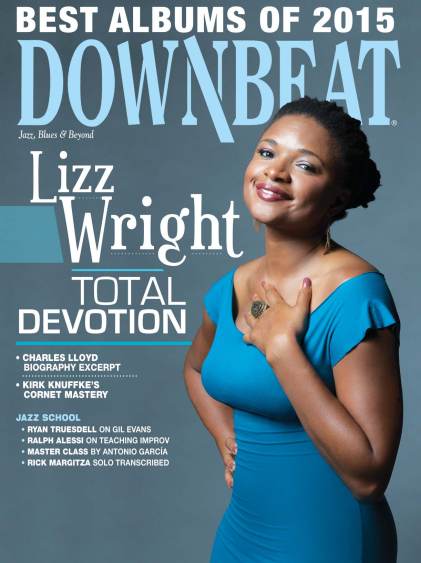
My January 2016 DownBeat interview/profile  of the terrific, genre-defying singer-songwriter, in which she discusses her near-death experience, her roots in Southern gospel music, and her transcendent new album, Freedom and Surrender.

Leave a comment

Filed under Larry Klein, Lizz Wright, Toshi Reagon

“Miles Ahead” in the April 2016 DownBeat

02_Resized_April_2016_DownBeat_cover

My DownBeat Magazine cover story about the making of the new Don Cheadle film “Miles Ahead” has been mailed to subscribers and will be on newsstands next week. It includes interviews with director/star Cheadle, Herbie Hancock, composer Robert Glasper, and members of Miles’s family. Here’s the cover. To see a trailer for the film, go here: https://www.facebook.com/milesaheadfilm/

Leave a comment

Filed under Don Cheadle, Downbeat, Herbie Hancock, Keyon Harrold, Miles Davis, Music Writing and Clips, Robert Glasper

The Sound of Film to Come (The Guardian)

The Sound of Jazz to Come (Guardian)

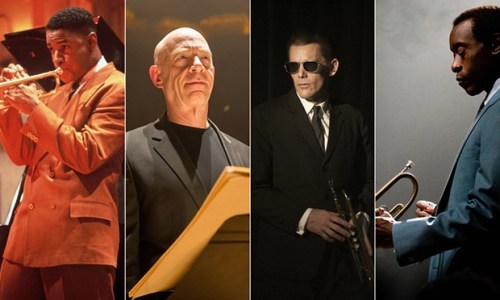
Here’s my first piece for The Guardian: a look back on the history of jazz-on-film – the good, the bad and the ugly – pegged to the forthcoming release of two remarkable films about jazz. “Born to be Blue,” with Ethan Hawke as Chet Baker, opens March 25. Don Cheadle’s “Miles Ahead,” about you-know-who, opens April 1.

The article includes a list of my five favorite films about jazz and jazz musicians. The Guardian didn’t have room for my honorable mentions, but here they are:

  • Keep On Keepin’ On (2014) – poignant, inspirational documentary about the great trumpeter Clark Terry and his star pupil, the blind pianist Justin Kauflin;
  • Mo’ Better Blues (1990) – Spike Lee’s serious attempt to portray the lives of modern jazz musicians, with stirring music by the Branford Marsalis Quartet and Terrence Blanchard);
  • Ray (2004) – Taylor Hackford’s conventional but still exhilarating biopic about Ray Charles, with a pull-all-the-stops-out performance by musician/actor Jamie Foxx; and
  • Robert Altman’s Kansas City (1996) – Despite jazz being somewhat peripheral to the rather hackneyed crime story, it includes one of the best sequences of live jazz ever filmed, a cutting contest between Coleman Hawkins (saxophonist Craig Handy) and Ben Webster (saxophonist James Carter).

Leave a comment

Filed under Bing Crosby, Charlie Parker, Chet Baker, Clark Terry, Craig Handy, Dexter Gordon, Don Cheadle, Duke Ellington, Ella Fitzgerald, Louis Armstrong, Miles Davis, Nat King Cole, Robert Glasper

Blue Note Stars Set Sail on Queen Mary 2

By Allen Morrison, from DownBeat, Feb. 2016

Blue Note Jazz at SeaFor seven days in late October/early November, one of the hippest jazz clubs on the planet was no jazz club at all, but rather Cunard Lines’ flagship Queen Mary 2, during the inaugural Cunard/Blue Note “Jazz at Sea” Festival, during a transatlantic crossing from Brooklyn to Southampton, England.

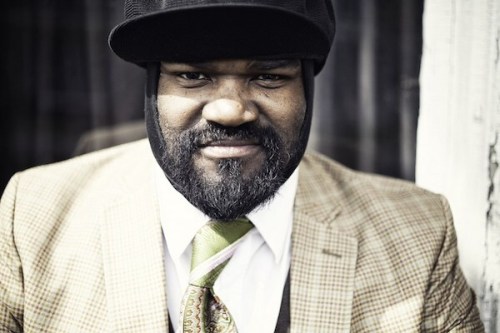
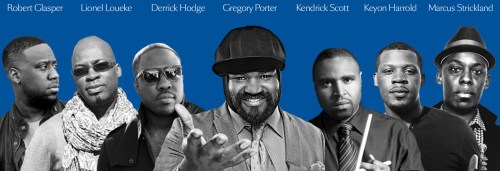
Accompanied by label president, bassist/producer Don Was, the musicians onboard included some of Blue Note Records’ biggest names: singer Gregory Porter, pianist Robert Glasper, and the Blue Note 75th Anniversary Band, an all-star group featuring Glasper, bassist Derrick Hodge, drummer Kendrick Scott, guitarist Lionel Loueke, saxophonist Marcus Strickland, and trumpeter Keyon Harrold, subbing for Ambrose Akinmusire. Other players onboard included drummers E.J. Strickland and Mark Colenburg, pianist Fabian Almazen, keyboardists Michael Aaberg and Federico Peña, guitarist Mike Moreno, and bassist/singer Alan Hampton.

Cunard has scheduled two more transatlantic crossings featuring Blue Note stars on the luxurious, 2,500-passenger ocean liner in 2016: westbound departing Southampton on August 1 and eastbound from Brooklyn on October 26.

The inspiration for the partnership was Cunard’s, according to Stanley Birge, vice-president of Cunard, N.A. By booking some of the world’s most prominent jazz artists, the passenger ship line, long known for its cultural programming, is trying to appeal to current customers but also to attract a new generation to the cruise line, he said.

The partnership was anything but inevitable, and success was not assured. The venerable British company, which is celebrating its 175th anniversary, is among the most tradition-bound of cruise lines, with a customer base that skews older and includes a high percentage of Brits. Blue Note, celebrating its 75th year, has a different kind of tradition, one of defying convention and expanding the boundaries of jazz. This made for some odd juxtapositions – for example, fox-trotting older passengers in formalwear in a ballroom immediately next door to a nightclub presenting forward-leaning jazz units led by Lionel Loueke or Derrick Hodge.

“Honestly, there was some fear, before we left the dock,” Was said in a shipboard interview, seated by a window in a quiet corner while watching the North Atlantic roll by. He described warily eyeing the passengers as they queued up to board the ship. “There was a disparity between who you’d perceive the jazz audience to be and who was getting on the ship. But it’s been incredible, man! The idea was to give people a taste of something exotic – but that didn’t mean they’d like the taste of it. There was no guarantee. But I think it’s been hugely successful,” he said, noting the growing numbers of passengers showing up for the nightly jazz sets and stopping him in the hallways to express their appreciation for the music.

The experiment got off to rather a shaky start after dinner on the first evening, on the stage of the ship’s 1,094-seat Royal Court Theatre, with the odd combination of a typical cruise ship revue and straight-ahead jazz. The show featured a decidedly un-hip quartet of singers in musty, English music-hall-style recitations of “The Good Life” and “Mack the Knife” (done mambo-style), performed to a canned Midi soundtrack; the big finish involved showgirls in extravagant feathered costumes. After about a half-hour, incongruously, Don Was appeared in his usual shades, dreadlocks and cowboy hat. “How many of you are familiar with Blue Note Records?” he asked. A smattering of applause. “How many are jazz fans?” Another smattering.

After explaining a bit of the Blue Note label’s history and assuring the audience that “you don’t need an advanced degree; jazz is a conversation,” he introduced the Blue Note 75th Anniversary Band, calling them “the best jazz musicians in the world.” (No pressure.) The atmosphere seemed a little tense as the band came out and silently took their places, no one knowing how this would fly with the cruise passengers. They launched into Ornette Coleman’s “Turnaround,” with a series of playful solos that sometimes left conventional tonality behind. It was a statement, almost defiant, that there would be no compromises. Somewhere between a quarter and a third of the audience headed for the exits during the extended soloing.

Nevertheless, by the time they took the stage again a few nights later as the evening’s main performers, the 75th Anniversary Band had made a few adjustments, incorporating more familiar jazz standards like “So What?” and “In Your Own Sweet Way,” to meet the audience halfway. “I thought they were most generous in understanding that a large portion of the audience was uninitiated,” Was said. “They played half of Kind of Blue last night!” he laughed. “It was really fun. It’s not something they would normally play.” This time the audience remained for the whole show and responded warmly.

That response peaked over the next two nights with several appearances by Porter, the crowd-pleasing featured performer. He was backed by the 75th Anniversary Band, in a tight, soulful set featuring brief but tasty solos by the all-stars (a full review will be posted online). Other small group performances in various venues – a mid-ship lounge called the Chart Room, the G-32 night club, and a movie theater/planetarium – featured Glasper’s trio, and groups led by Kendrick Scott, Marcus Strickland, Loueke and Hodge, among others. They drew a growing audience of passengers as the voyage progressed, attracting both the minority who were jazz fans prior to sailing and many new converts.

On the question of whether the paring of Blue Note and Cunard would win new customers to Blue Note or help the label sell more CDs, Was was thoughtful. “My overall feeling, speaking not as a music fan but as a label president, is that selling records to consumers is not a viable business anymore. So I’m very interested in new ways to…monetize the music – or else it’s gonna end. So this is a radical, futuristic model for how everybody can make a little bread, and you can bring in new people to hear the music.”

Leave a comment

Filed under Blue Note, Blue Note Jazz at Sea, Cunard, Derrick Hodge, Don Was, Downbeat, Gregory Porter, Kendrick Scott, Keyon Harrold, Lionel Loueke, Marcus Strickland, Robert Glasper

My 10 Best Jazz Albums of 2015 (Jazz Times)

This slideshow requires JavaScript.

Here’s a list of my favorite jazz CDs of 2015, as published in Jazz Times.

New Releases:
1. Tony Bennett & Bill Charlap, The Silver Lining: The Songs of Jerome Kern(RPM/Columbia)
2. Maria Schneider Orchestra, The Thompson Fields (ArtistShare)
3. Rez Abbasi Acoustic Quartet, Intents and Purposes (Enja)
4. London, Meader, Pramuk & Ross, The Royal Bopsters Project (Motéma)
5. Aaron Diehl, Space Time Continuum (Mack Avenue)
6. Dave Stryker, Messin’ With Mister T (Strikezone)
7. Rudresh Mahanthappa, Bird Calls (ACT)
8. Cécile McLorin Salvant, For One to Love (Mack Avenue)
9. Nilson Matta, East Side Rio Drive (Krian)
10. Luciana Souza, Speaking In Tongues (Sunnyside)

Historical:
1. Tony Bennett/Bill Evans, The Complete Tony Bennett/Bill Evans Recordings(Fantasy)
2. Wes Montgomery, In the Beginning (Resonance)
3. Miles Davis, At Newport 1955-1975: The Bootleg Series Vol. 4 (Columbia Legacy)

Honorable mentions: Karrin Allyson, Many a New Day: Sings Rodgers & Hammerstein (Motéma); Chris Dingman, The Subliminal and the Sublime (Inner Arts Initiative), Chris McNulty, Eternal (Palmetto); Arturo O’Farrill & the Afro-Latin Jazz Orchestra, Cuba: The Conversation Continues(Motéma); Robert Glasper, Covered (Blue Note); Jonathan Kreisberg, Wave Upon Wave (New For Now); Duduka da Fonseca Trio, Jive Samba (Zoho)… and I may add some others as they occur to me.

Leave a comment

Filed under Aaron Diehl, Allen Morrison, Chris McNulty, Jazz Times, Karrin Allyson, Maria Schneider, Rez Abbasi, Robert Glasper, Royal Bopsters

A note to readers re: DownBeat server problem

Thanks to my friends who pointed out that many of my links to articles that appeared on DownBeat.com are currently not working. This is due to a server problem at DownBeat’s web provider.  They are working to fix it, but it may take several days before it is resolved.  In the meantime, any new posts will be either self-contained or link to other verified sources.

Leave a comment

Filed under Allen Morrison, Downbeat

The Aaron Diehl Interview – director’s cut

2977_aaron20diehl

In November, DownBeat published a condensed version of my conversation with the brilliant young pianist Aaron Diehl, who some of you may know best as the accompanist and musical director for singer Cecile McLorin Salvant. A pianist of extraordinary refinement like, say, Ahmad Jamal, he can also swings as hard as Oscar Peterson, who was also an influence.

Aaron and I talked music for nearly three hours in his Harlem living room, as he sat at his Steinway grand illustrating his remarks with musical examples. DownBeat.com has just published an extended version of this Q&A, along with a sidebar about his exploits as a private pilot.  Enjoy, then check out his playing on his recent album Space Time Continuum (Mack Avenue) and on Cecile’s recent album For One To Love (Mack Avenue).

Leave a comment

Filed under Aaron Diehl, Cecile McLorin Salvant, Downbeat, Music Writing and Clips, Piano

Guitarist Lionel Loueke On Herbie, Don Was, and His New Blue Note Album

2971_lionel_loueke20_by_mathieu_bittonBorn in Benin in West Africa, jazz guitarist Lionel Loueke has been Herbie Hancock’s guitarist for the past decade. He’s also a member of the all-star Blue Note 75th Anniversary Band with Robert Glasper, Derrick Hodge, Kendrick Scott, Marcus Strickland and Ambrose Akinmusire (trumpeter Keyon Harrold subbed for Akinmusire on the voyage). Lanky and soft-spoken, Lionel speaks excellent English, accented by his native Fon and French. I had the pleasure of interviewing him during the Cunard/Blue Note Jazz at Sea Festival on board the Queen Mary 2 in November. Here are some highlights, as published in DownBeat.

All week long on the ship, people were talking about Lionel’s vocals as well as his guitar playing, especially his brilliant use of a harmonizing box to create a ghostly choir effect on “Message of Hope,” a song written by band-mate Hodge. Lionel told me that song will be included on the first album by the Blue Note 75th Anniversary Band (formerly known as “Our Point of View), to be released later this year.

Leave a comment

Filed under Ambrose Akinmusire, Blue Note Jazz at Sea, Derrick Hodge, Gregoire Maret, Herbie Hancock, Kendrick Scott, Keyon Harrold, Lionel Loueke, Marcus Strickland, Robert Glasper

Gregory Porter Talks New Album (DownBeat, 12/29/15)

imageGregory Porter recently headlined the first Cunard/Blue Note Jazz at Sea transatlantic crossing on the Queen Mary 2, backed by the all-star Blue Note 75th Anniversary Band. Here’s a shipboard interview I conducted with the Grammy-winning singer/songwriter, in which he talks about playing with such an elite band and his forthcoming album, his second for Blue Note.

Leave a comment

Filed under Blue Note Jazz at Sea, Derrick Hodge, Don Was, Gregory Porter, Keyon Harrold, Robert Glasper

The Cat Can Swing: An Evening @ Dizzy’s with bandleader Andy Farber (Downbeat.com)

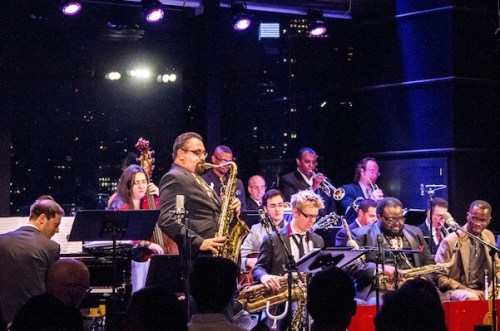
imageSaxophonist/arranger/bandleader Andy Farber is a New York treasure. I caught him at Dizzy’s Club at Jazz at Lincon Center recently, leading his 17-piece orchestra in a program that included two old favorites – “Seems Like Old Times,” and Neal Hefit’s theme from “The Odd Couple.” My report in Downbeat.

Leave a comment

Filed under Adam Birnbaum, Andy Farber, Downbeat, Jazz at Lincoln Center, Music Writing and Clips

I Visit Catherine Russell in Studio for ‘Harlem’ Sessions

2945_catherine_russell_credit_paul_kahn

Catherine Russell (Photo: Gene Guerrero)

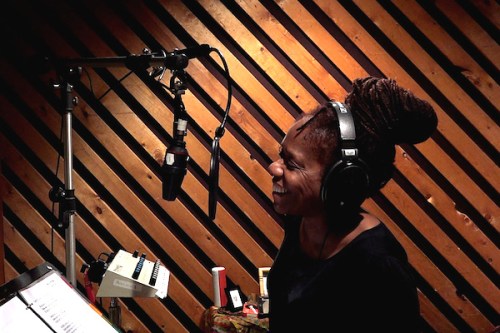
I had a great time last week at MSR Studios on 48th St., watching Catherine Russell and an ace 10-piece band (six horns plus a rhythm section) track a Dinah Washington blues classic for her new album – everything recorded live, no overdubs. My article, “DownBeat Visits Catherine Russell in Studio for ‘Harlem’ Sessions,” is here:


Leave a comment

Filed under Andy Farber, Catherine Russell, Downbeat, Music Writing and Clips

After 25 Years of @FOURPLAYjazz…

Fourplay

… these all-stars delivered the goods at the Blue Note. My review here.

Leave a comment

Filed under Blue Note, NYC, Bob James, Chuck Loeb, Downbeat, Fourplay, Harvey Mason, Music Writing and Clips, Nathan East

And congrats to the amazing @CecileSalvant…

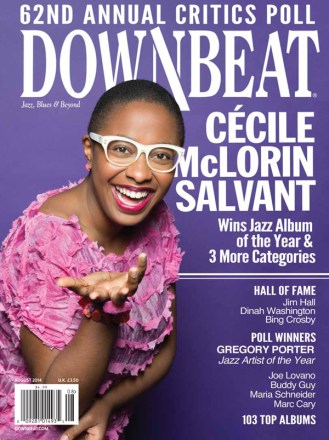
cecile-mclorin-salvant-downbeat-1

…for her 2nd #Grammys nomination in two years, this time for her 2nd album on @MackAvenueMusic, For One To Love, with the brilliant Aaron Diehl (piano), Paul Sikivie (bass) and Lawrence Leathers (drums). What a pleasure it was to write this profile of her, from the August 2014 DownBeat.

Leave a comment

Filed under Aaron Diehl, Cecile McLorin Salvant, Downbeat, Lawrence Leathers, Music Writing and Clips, Paul Sikivie

Congratulations to @KarrinAllyson on her #Grammys Nomination…

karrin-allyson-63191f…in the #Jazz Vocal category, for her imaginative new take on Rodgers & Hammerstein, Many A New Day (@Motema), which she arranged as well as sang. Congrats also to her co-creators, the fabulous duo of pianist Kenny Barron and bassist John Patitucci, and to c0-producer Michael Leonhart. Here’s my interview with Karrin about the project from the November 2015 DownBeat.

Leave a comment

Filed under Downbeat, John Patitucci, Karrin Allyson, Kenny Barron, Music Writing and Clips

GregoryPorter, All-Stars Celebrate Blue Note Records 75th Anniversary at Sea

2933_blue_note_cruise_credit_mga_media

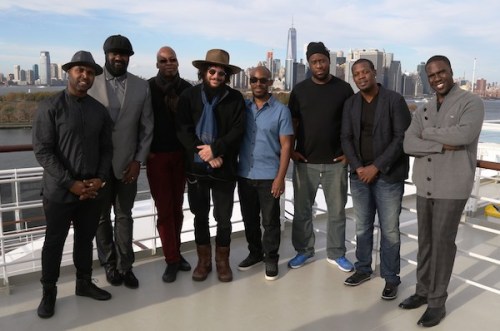
Kendrick Scott (left), Gregory Porter, Lionel Loueke, Don Was, Marcus Strickland, Robert Glasper, Keyon Harrold and Derrick Hodge aboard the Queen Mary 2 (Photo: Courtesy MGA Media Group)

Here’s the first of my reviews of the Cunard/Blue Note “Jazz At Sea” Festival on the Queen Mary 2, from DownBeat.com, focusing on singer/songwriter Gregory Porter’s show with the Blue Note 75th Anniversary Band.  The transatlantic crossing featured performances and interviews with Porter, pianist Robert Glasper, label president Don Was, and a dozen more Blue Note Records artists. My overall review of the week-long crossing will appear in the February print edition of Downbeat.

Leave a comment

Filed under Blue Note, Blue Note Jazz at Sea, Derrick Hodge, Don Was, Downbeat, Gregory Porter, Kendrick Scott, Keyon Harrold, Lionel Loueke, Music Writing and Clips, Robert Glasper