Two all-time piano greats are visiting Boston this weekend, and I had to see them both. First up, on Halloween night, the most genial of piano virtuosos, Bill Charlap. He was at the RegattaBar in the Charles Hotel, with his sensitive, disciplined trio of David Wong, bass and Dennis Mackrel, drums. Bill is the master of dynamics, of the elegant run, of how to keep a solo interesting. Impeccable classical technique in the service of swing.
Can an acknowledged master like Bill be said to be under-appreciated? I think so, at least by the critics, too many of whom are eager to dismiss him as a purveyor of the dreaded standard repertoire. Yes, he played a Cole Porter tune (“In The Still of the Night”) and a Richard Rodgers tune (a medley of “If I Loved You” and “It Never Entered My Mind”), but his set also included little-heard classics by Tommy Flanagan, Herbie Nichols, Gerry Mulligan, and Jim Hall. His approach to them is entirely original. What his critics miss is that he uses standards only as a springboard for his own wild imagination and scorching pianism. The trio played for 75 minutes; it seemed like 15.
Joe Farnsworth is a man of many mottos: “Listen to learn, and learn to listen;” You can never be wrong if you know the song;” and, of course, “Time to Swing.” He’s more than a drummer – he is a sensitive, generous musician with big ears and a big heart. His stories, often quite funny, are instructive, whether you aspire to play this great music or just appreciate it more deeply. It was a joy talking to him about his life and times for DownBeat Magazine. Now, for those who would like more of Joe and his stories than the magazine had room for, here’s the “director’s cut” of my September 2025 feature.
{UPDATE: As of about October 2, the online version of this article on DownBeat.com has been expanded to include the full text of the article below. You can read it here or read it there! – Allen}
Joe Farnsworth Plays “The Big Room”
By Allen Morrison
When he was 12 years old, the hard-swinging veteran drummer Joe Farnsworth had a fateful encounter with his idol Max Roach, the bebop pioneer.
Prior to that, Farnsworth had already been playing drums and attending jam sessions in and around his hometown of South Hadley, MA, thanks to his four older brothers, musicians all. As a budding young drummer, he had been emulating Buddy Rich and Sonny Payne of the Count Basie Orchestra. He used to play along with the Count’s “April in Paris.”
“Then my older brother John had me learn Charlie Parker’s version of ‘Slow Boat to China’ and ‘Chi Chi,’ with the great Max Roach on drums,” Farnsworth told me in a pair of recent Zoom interviews. “When I started hearing Max, that was like the big change in my life… (to) that style of music and drumming.
“Around that time, my brother John drove me to UMass-Amherst to see Roach give a masterclass. We came into the room, and there was a guy playing piano. It was just the three of us. I’m like, ‘Damn, is that Max Roach?’ Because I had never seen his face, and he was playing piano. Then he stopped playing and says, ‘What are you guys here for?’
“I said, ‘I’m here because I want to play like Max Roach.’ He didn’t answer; he just kept playing. About 10 minutes later, he asked, ‘Do you know who Billy Strayhorn is?’ I said no. He kept playing music – beautiful music – on the piano. He finally stops and says, ‘If you don’t know Billy Strayhorn, you don’t know anything about the drums.’
“I was 12, and I didn’t really know what he meant by that. But I know now… He meant that… you first and foremost are a musician, and you need to learn about music… and open your mind and ears to all the possibilities… Then you’re able to play music instead of just playing drums.”
Farnsworth’s jazz education continued with private lessons with the legendary drum teacher Alan Dawson and at William Paterson College. “But,” he says, “the school I wanted to go to was the school of Cedar Walton and George Coleman.” He headed to New York City.
—————
When you see Farnsworth on a gig, he is always dressed to the nines. It’s his way of paying homage to the jazz masters. “I’ve been doing it ever since I started making gigs in 1986. Art Blakey did it. McCoy. Miles. Charlie Parker. That was the thing to do. My first big gig was with Benny Golson. He always wore a suit. I did, too. Milt Jackson, George Coleman, Cedar Walton. I wanted to be like that.”
Coming out of the hard bop tradition, Farnsworth, 57, has played with a formidable list of jazz masters, including Tyner, Walton, Golson, Coleman, Horace Silver, Harold Mabern. He toured with Diana Krall and spent 16 years with Pharoah Sanders. He is a charter member of the supergroup One for All with his former Paterson classmate Eric Alexander. In recent years he has helped nurture – and is sought out by – a younger generation of musicians, including pianist Emmet Cohen, in whose trio he plays, and the sensational young tenor player Sarah Hanahan.
Both Cohen and Hanahan are featured on his latest album The Big Room (Smoke Sessions), his 8th as a leader. Rounding out the A-list of players is Joel Ross, vibraphone; Jeremy Pelt, trumpet; and Yasushi Nakamura, bass.
Farnsworth’s drumming is characterized by crispness; rhythmic clarity; melodicism; a sensitive, musicianly use of dynamics; and a bulletproof sense of swing. His impeccable technique has given him the freedom to celebrate a tradition that includes drummers from Roach to Roy Haynes, Billy Higgins, and Tony Williams, while enjoying the freedom to go well beyond that tradition.
In his liner notes for Farnsworth’s 2020 album Time to Swing, drum master Billy Hart likens him to an orchestra conductor, writing, “Somehow the conductor keeps perfect time for 80 musicians without hitting anything. How does he do that? It’s a result of his knowledge of the music, and the enthusiasm that this knowledge gives him is what he shares with the rest of the orchestra. I think that’s what Farnsworth does.”
Talking by Zoom about his friend and colleague, Emmet Cohen said, “I think he’s one of the greatest ever. An absolute legend. He used to go down, week after week, and sit by Elvin Jones, Tony Williams, Billy Higgins, and Louis Hayes, and would just absorb their musicality and their power… It feels so good to be around him. And you know he’s got your back. I never imagined I’d have a friendship with someone 20 years my senior that would feel so kindred and overwhelmingly positive in my life.”
The younger players admire his discipline, an almost monastic dedication to the art form, which comes out in many ways: yes, the suit, tie, and pocket square; but also the way he takes care of his body and spirit. “It’s the standard that he holds for himself,” Cohen said. “Dressing. Running every day. Going to church no matter what the language or what country he’s in. Staying centered. I’ve never seen him falter. He’s been an enormous blessing in my life.”
———
South Hadley, Mass., pop. 17,000, in the western part of the state, was never exactly the jazz capital of the world. Yet being the son of a high school band director, and with four older brothers who all played, Farnsworth’s life was filled with jazz.
“Listening to music was the biggest thing in my life,” he said. “It was really important to me. Still is. I used to love having listening parties with my brothers. We had thousands of records.
“I used to sleep with my oldest brother, David. He was the original drummer. He had a nice set of Ludwigs. He’d go off to school and say, ‘Don’t touch my drums.’ So, I’d look out the window until I couldn’t see him anymore, and I’d plop on the drums.”
The budding musician would go from room to room in the house in South Hadley, listening to his brothers’ favorites. With David, he would listen to the Temptations and O’Jays, but also the Buddy Rich and Basie bands. “The next room over was James. He was a saxophone player and was into Sonny Stitt and Sonny Rollins… John was a trombone player, so he liked Chicago, but he was also into Charlie Parker, J.J. Johnson, and Clark Terry. So, I’d go into that room and listen to that. I like to joke that it was like having my own mini 52nd Street.”
———–
Dawson’s approach to teaching young drummers was to encourage a holistic approach to the music. It wasn’t just about the drumming; it was about really learning the tune, melody and lyrics, and playing what was best for it.
Farnsworth does the same with his own students. He recalled the first tune that he learned from Dawson was “Old Devil Moon.” “It was the J.J. Johnson record with Elvin Jones on drums. (He had me) play the melody. That was the first time that I would sing the melody while I was playing. And I remember him saying, ‘Well, the good thing is that you have a love for Max Roach.’ But the main part of the lesson was (him saying) that ‘you’ve got to learn how to sing the melody freely so you’re able to play more freely.’” In other words, instead of emulating Roach, Dawson wanted him to learn the song.
“For 40 years, I tried to play the perfect Max Roach solo. I wanted to be him and guess what? It never happens.” It’s only in recent years, Farnsworth said, that he stopped chasing Roach and his other drum heroes and concentrated on his own unique voice.
When he got to New York in 1986, he discovered the musician union phone book that belonged to his older brother John, who lived on 106th and Amsterdam Avenue. He started cold-calling his jazz heroes who lived in New York. Some of them hung up on him. But when he reached the “T” section, he dialed iconic bebop drummer Arthur Taylor, who agreed to take him on as a student.
“A.T. said, ‘You’re lucky you’re on time, because if you’re not on time you can’t play in time.’ The first few lessons we sat there and just listened to Sarah Vaughan sing.” Taylor told his young charge a story about how he was once playing a ballad, and the iconic Basie drummer Papa Jo Jones came up to him and hit him in the head.
“He said, ‘Hey, you little goober head, you sound terrible!’ And A.T. was like, ‘Hey, man, why’d you hit me in the head?’ And he says, ‘You don’t know the tune!’ And A.T.’s like, ‘Yo, come on, man, it’s just a ballad.’ But Papa Jo was right.” Farnsworth remembered that he and Taylor listened to Vaughan sing “Don’t Blame Me,” then talked about how, when Lester Young and Miles Davis were learning a ballad, they would listen to Sinatra sing it then Charlie Parker play it.
Like Dawson, Taylor encouraged the young drummer to learn the lyrics, saying “If you want to be part of the glory, you gotta know the story,” and “You can never be wrong if you know the song.”
—————–
What is “the big room,” the concept behind Farnsworth’s new album? It seems to have more than one meaning, describing a place where constraints on expression disappear, but also an approach to time.
Farnsworth has said, “Jackie McLean talked about being at such a height of greatness that you’re able to go into The Big Room, where there’s no furniture and no paintings on the walls. You’re able to arrange the room anyway that you want, but only a few people ever get there – greats like John Coltrane or Ornette Coleman. It’s like what, Roy Haynes said about playing with Coltrane – it’s freedom with discipline.”
Cohen thinks the concept also has to do with the way the masters talked about time. “Joe likes to call me “Emit,” Cohen said, “because Joe’s teacher, Arthur Taylor used to say ‘It’s all about Emit’ – ‘time’ backwards. It comes down to the space between the quarter notes when you’re swinging.”
The sense of “freedom with discipline” is palpable on the record. Remarkably, it was tracked in a single day during a recording session on the stage of Smoke, the Upper West Side nightclub that spawned the label. The eight songs cover a wide spectrum, from post-bop burners like Hanahan’s opener “Continuance” and Cohen’s “You Already Know”; to altered blues (Pelt’s “All Said and Done”); pensive ballads (Joel Ross’s “What Am I Waiting For?”); and the triumphant boogaloo (Farnsworth’s “Prime Time”) that closes the album.
For Farnsworth, the music is never about ego or chops. It’s about being the best person you can be, on and off-stage.
“I remember meeting Billy Higgins and asking him why he smiled so much. ‘Smiling Billy Higgins,’ people called him. He told me he made changes so he could become happy, joyous, and free. He changed his lifestyle, stopped doing certain things. Became Muslim, started listening to God. Freed himself from toxic relationships. Set healthy boundaries. Certain people he had to let go of.
“I was determined to be like that, but I didn’t know how. About 13 years ago, I decided to do the same thing – change my life. Being a father of three, I stopped hanging out after the gig, stopped drinking. I decided to become Catholic – I wasn’t anything before that. I started listening to a higher power.
“‘Listen to learn, and learn to listen’ – that was what Art Taylor taught me. I wanted to be happy, joyous, and free… to be a better father, a better drummer, and be of service to younger people.”
Farnsworth once toured with Benny Golson. Two legendary players, trombonist Curtis Fuller and trumpeter Art Farmer, joined the band for its final dates. “One night when Art played ‘I Remember Clifford,’ I noticed that Curtis started to cry. Little did I know that Art was dying of cancer at the time.
“Being on the road with these guys showed me the level of fellowship, commitment, love, and respect that they had for each other. I learned just how big their hearts were. What I learned was that they were giants of men. The instruments (they mastered) were just by-products.
“Art gave me a pocket square to put in my jacket. He said, ‘Hey, man, you need to look good if you want to hang around me. Don’t embarrass me.’ To this day I wear it.”
Wayne Shorter at Jazz at Lincoln Center (photo by Fran Kaufman)
Wayne Shorter was a hero to everyone in the jazz world, a visionary composer and an unequalled improviser who retained a childish sense of wonder and play. There was no one like him. I’m so glad I got to see him play live with his quartet at Jazz at Lincoln Center in 2012. Here’s how the piece began:
An hour before pianist Danilo Pérez went onstage with the Wayne Shorter Quartet on April 28 at Jazz at Lincoln Center’s Rose Theater, I asked him what the group would be playing. He laughed. “We never know, man.” Well, how did it go last night? “It was exciting—and scary.”
Smalls Jazz Club, NYC. The club began live-streaming shows, with no audience physically present, on June 1.
Jazz is “the least socially distanced art form,” says Spike Wilner, pianist and proprietor of two of my favorite jazz clubs, Smalls and Mezzrow. It is an art form “that requires people to interact intimately…, one best served in a crowded, cramped, basement full of people breathing, talking, listening.”
How are jazz club owners and festival producers coping with the shutdown caused by the pandemic, and what might the future hold? To get some answers, I spoke with club managers and festival producers in the U.S. and U.K. The results were published in DownBeat’s July 2020 issue. An expanded version is below.
Compared to the other casualties of the worldwide COVID-19 pandemic, it barely registers in media coverage and the public consciousness.
Yet the sudden, worldwide shuttering of jazz clubs and other venues for live music in mid-March constituted the most devastating blow to jazz in its history, strangling the livelihood of musicians and, in many cases, threatening their ability to survive in the profession.
If the indefinite closures left musicians staggering, the cancellation of most spring and summer jazz festivals was the coup de grace. No one is certain when, or even if, things will ever return to normal.
As Spike Wilner, jazz pianist and proprietor of the iconic New York clubs Smalls and Mezzrow, put it in a recent newsletter to the clubs’ fans, “What will become of the least socially distanced art form? One that requires people to interact intimately? One that is best served in a crowded, cramped, basement full of people breathing, talking, listening?”
The shutdown darkened grand concert venues, like New York’s Jazz at Lincoln Center and London’s Ronnie Scott’s, and little hole-in-the-walls alike. So many spring and summer jazz festivals have been cancelled – including majors like Newport, Montreal, the New Orleans Jazz & Heritage Festival and Switzerland’s Montreux Jazz Festival – that it’s easier to cite those that have not (yet) been cancelled, e.g., the Monterey and Detroit Jazz Festivals, both still scheduled for September, as of press time.
Jazz musicians have shown considerable resilience, with many taking to social media platforms to stream live performances from their living rooms, teaching and collaborating online, while some attemptto secure unemployment benefits for freelancers, mandated by the federal CARES Act, but only spottily implemented by states.
Meanwhile, club owners in the U.S. and abroad are, like all small businesses, fighting to survive and pay their rent and other monthly bills in the face of a sudden and complete stoppage of revenues.
In April, more than 800 independent concert presenters, in an effort to prevent their possible extinction, banded together to form The National Independent Venue Association (NIVA). “Independent venues were among the first to close as COVID-19 spread across the country, and unfortunately, are also likely to be among the last to reopen,” the group stated in a press release. The group is lobbying Congress for specific funding programs to assist them for the duration.
Temporary moratoriums on evictions in some U.S. states, including California and New York, have helped some venues buy time, although without relieving them of their rent obligations over the long term.
Catalina Popescu, owner of Catalina’s Jazz Club in Los Angeles, has been operating since 1986. She shut down March 15 and laid off her 25 staff members. “It’s been very painful,” she said. “We’re OK for the time being. Nobody can force you to pay rent. [The landlords] send me an email every so often, but they can’t do anything about it… I fought for this business for 34 years, to stay open, to make it successful, to be a great place for people to listen to music and for musicians to perform. I hope we’ll be able to reopen.”
The situation is similar in London, where Simon Cooke, general manager of Ronnie Scott’s said, “We have nearly 100 on the payroll. All but six are furloughed. We’re hoping the government’s scheme will keep everybody happy.” The U.K. is providing 80 percent funding to small businesses who maintain payroll.
“We’re very established, almost a national institution, been around 60 years, a fondness in the community. Everything we do is massively supported. We have about 3,500 paid members, who are very supportive; most renew annually. I think we’ll be alright. If it’s a very long layoff, it may be a slow restart. I’ve been looking after the place 12 years. When I started, the business wasn’t in great shape. We built it up, to the point that we’re full 98 percent of our shows. If we have to do that again, that’s what we’ll do. At least we know how – we did it once.”
In late March, Smalls’ Wilner told me, “Right now, I’m waiting to see if Smalls will exist in another month or so.” At the time, the venue and its sister club, Mezzrow, both of which are located on the same block in high-rent Greenwich Village, had rent payments of $20,000 apiece coming due. “I think I’ll be able to get through April, but after that, I don’t know.”
Then, on April 15, he posted on Facebook, “This club is coming back – we are not done!” What changed? “We got a PPP loan,” Wilner said in late April, referring to the federal program that is providing low-interest loans to small businesses, loans that, under conditions that are still unclear, may be fully or partially forgiven. “That will help us secure Smalls for the next 4-5 months, until we can get things going again. With Mezzrow, I’m not sure what’s going to happen yet.”
The week before, Wilner completed the transformation of Smalls and Mezzrow into a nonprofit arts foundation, a project that had been in the works for two years. The SmallsLIVE Foundation (www.smallslive.com) subsidizes the expense of operating the clubs, assisting musicians, and sponsoring jazz education programs. In return for a donation of as little as $10, supporters can access a prodigious archive of performances from both clubs, which has grown to over 17,000 recordings since Wilner began taping performances in 2007. Royalties are distributed to the more than 3,500 musicians whose performances are included in the archive, based on the number of their streams.
One of the first major donors to the new foundation was rock icon Billy Joel. Wilner described Joel’s $25,000 donation as “a shot in the arm.”
“My goal is to open Smalls first, as soon as [the city] lets us run bars,” Wilner said. “What I’d like to do is raise money to live-stream from the club and start a club schedule again. I would only do live streaming if I can pay the musicians for their performances. I think that could happen. My goal is to keep the clubs afloat [until then].”
Wilner began live-streaming shows from Smalls on June 1. Only performers, a sound engineer, and a few staff are present. The shows have attracted hundreds of viewers from around the world. The shows can be viewed for free on Facebook at https://www.facebook.com/smallslive/. Another New York jazz mecca, The Village Vanguard, announced it will begin live-streaming on June 13 at https://villagevanguard.com/live-stream/.
In mid-April, Jay Sweet, Executive Producer of the Newport Festivals Foundation (NFF), which produces both the Jazz and Folk Festivals, was consulting daily with the governor of Rhode Island, Gina Raimondo. “Her focus is on keeping people alive,” he said at the time. “We’re on a state property (Fort Adams State Park); it’s 100 percent Rhode Island’s decision…. We would never jeopardize the safety of our fans and our artists.”
On April 28, both festivals were cancelled. All artists who were invited to perform in 2020 have already been invited for the 2021 editions.
Sweet is not worried about the foundation’s survival. “The foundation will be OK. George will ensure that,” he said, referring to founder George Wein, now 94. “Right now I’m 100 percent focused on keeping our musicians musicians. Our goal is to give the money back to the next generation of artists who will play these festivals. That’s the biggest part of our job.”
Wilner, who went through “a dark period” following the closing of the club, said his mood lifted considerably after receiving a phone call from Wynton Marsalis in early April. Marsalis was working to secure funds for musicians and small clubs. The Louis Armstrong Foundation, of which Marsalis is board president, had established an Emergency Fund for Jazz Musicians, to award one-time grants of $1,000 to freelance jazz musicians affected by the shutdown. The foundation committed to awarding 1,000 grants, totaling $1 million.
“He asked me to be on his committee to help decide who gets the money,” Wilner said. “I put together a list of about 350 musicians who I thought could use it. They did a beautiful thing. It’s not a lot of money, but it’s a tremendous morale booster.” Wilner’s own SmallsLive Foundation has also begun making emergency donations to jazz musicians in need.
Similarly, NFF established a Newport Festivals Musicians Relief Fund. Starting with a small, $20,000 emergency fund, Sweet and his Board members decided this was a “break-glass-in-case-of-emergency moment. After three weeks, the fund had grown to $160K, thanks to donations. We’ve had 500 applications and so far, fulfilled 275 of them. These are for musicians who have played Newport and other Rhode Island musicians, musicians whose names you would know. They each receive anywhere between $300 and $1,000. It’s like passing out band-aids on the battlefield,” he said.
With the jazz world reflecting the disarray of the larger world, the future for jazz venues is murky. “Jazz tourism in NYC is a big thing,” Wilner said. “We’re so dependent on it; any club owner in town will tell you that. We can’t run at capacity without our tourists, and God knows when that’s gonna come back to NYC.”
The concert business is another unknown. “The one thing that will never go away is this: there’s something in our human DNA that needs to commune with others,” said Newport’s Sweet. “For some it’s religion; for some, sports; for some, music. I think the word “normal” will be redefined. The one thing I still believe in, for my entire professional career, is the desire for human beings to congregate around music. It’s being tested now. I don’t think live music is remotely close to dead. People just cannot live without it.” — Allen Morrison
Here’s my first piece for The Guardian: a look back on the history of jazz-on-film – the good, the bad and the ugly – pegged to the forthcoming release of two remarkable films about jazz. “Born to be Blue,” with Ethan Hawke as Chet Baker, opens March 25. Don Cheadle’s “Miles Ahead,” about you-know-who, opens April 1.
The article includes a list of my five favorite films about jazz and jazz musicians. The Guardian didn’t have room for my honorable mentions, but here they are:
Keep On Keepin’ On (2014) – poignant, inspirational documentary about the great trumpeter Clark Terry and his star pupil, the blind pianist Justin Kauflin;
Mo’ Better Blues (1990) – Spike Lee’s serious attempt to portray the lives of modern jazz musicians, with stirring music by the Branford Marsalis Quartet and Terrence Blanchard);
Ray (2004) – Taylor Hackford’s conventional but still exhilarating biopic about Ray Charles, with a pull-all-the-stops-out performance by musician/actor Jamie Foxx; and
Robert Altman’s Kansas City (1996) – Despite jazz being somewhat peripheral to the rather hackneyed crime story, it includes one of the best sequences of live jazz ever filmed, a cutting contest between Coleman Hawkins (saxophonist Craig Handy) and Ben Webster (saxophonist James Carter).
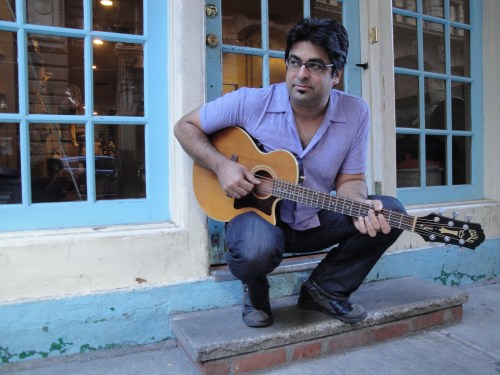
Jazz guitarist Rez Abbasi, whose family came to Southern California from Pakistan when he was 4, grew up playing in bands that worshiped Van Halen, Rush, and other prog rockers. When he discovered Charlie Parker at age 16, he lost interest in rock in favor of bebop – acoustic music that swung. As a result, Abbasi never listened to jazz fusion artists like Chick Corea, John McLaughlin and Weather Report – until now.
Abbasi’s new album Intents and Purposes (Enja) explores classics of the fusion era with a twist – everything is played on acoustic instruments by the Rez Abbasi Acoustic Quartet, including Bill Ware (vibraphone), Stephan Crump (bass) and Eric McPherson (drums). The results are beautiful and amazing. Even if you don’t like fusion, perhaps especially if you don’t like it, this album is a must-hear. My profile of Rez from the March 2015 DownBeat is here. You can hear a few samples from the album and view a “making of” video here.
My DownBeat cover story on singer/songwriter Gregory Porter is out now. Read it here. Or better yet, support print journalism, and buy it at a newsstand (Barnes & Noble carries it). Lots of great stuff in the issue, including coverage of the Montreal and Toronto jazz festivals (I wrote the latter) and tons of interesting record reviews.
Gregory Porter at home in Brooklyn (photo by Allen Morrison)
RT @amorrison2 “#GregoryPorter’s “Liquid Spirit” drops Sept 17. Happy to say my profile of him is cover of Oct #DownBeat, out soon. ” Gregory Porter – Liquid Spirit video
What did Tia Fuller learn from playing in Beyoncé’s all-female band? See my interview with the alto sax star — winner of two DownBeat Rising Star awards this year for alto and flute — from the August 2013 DownBeat.
Bobby McFerrin at sound check, Adelphi University. Photo by Adam McCullough
After years of singing mostly songs without words, or in improvised languages of his own invention, Bobby McFerrin has returned to singing the type of songs in which the lyrics are as essential as the music, with words that express his deepest yearnings: spirituals. In my interview with McFerrin, he talks about his early career and influences, why he considers himself a “folk” musician, and the process of creating his new album spirityouall.
Jane Monheit, one of the most accomplished jazz singers of her generation, no longer strives for perfection. Here’s my article from the June 2013 DownBeat.
Luciana Souza and producer/husband Larry Klein discuss her two new albums, “The Book of Chet” and “Duos III,” their music, their marriage and much more in this interview published in the October 2012 DownBeat. You can read it here.
I recently traveled to L.A. to interview the wonderful singer/composer Luciana Souza – and her equally brilliant producer-husband Larry Klein – for a feature story in DownBeat.The article will preview two new albums to be released simultaneously in late August.










 Allen Morrison - Music Journalist, Jazz Pianist, Songwriter, Lecturer - Long Island, NY
You must be logged in to post a comment.